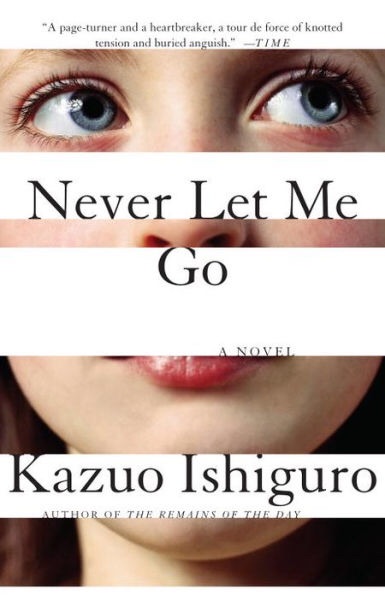
The many awards winning novel Never Let Me Go by the British author Kazuo Ishiguro was a bittersweet and oddly nostalgic journey. There is this underlying dystopian feeling to it but not as dark. Felt this way only because of how accepting the characters are of their reality, although confused and sometimes lost, they acknowledge that they were brought to this world with limits they can’t help.
To the reader, the darkness of what the future is bringing to them is unknown and later revealed as you go through the book. We get the sense that there is something ambiguous and dark looming in the distance but we’re preoccupied by the current situations and relationships that the unfortunate reality of the people living in this school is almost forgotten. Almost. The novel throws many hints in our way but you don’t see it coming. Like seeing a shipwreck about to happen but the size of the ship is unknown due to the fog.
It is sad, I couldn’t help but want to give our main character, Kathy H, a hug. I wished she had a better best friend. But don’t we all do the same, stick with people we know will end up hurting us but we feel comfortable around them regardless. Or rather, seek that comfort endlessly. I strongly felt for her and her situation.
The story opens up with Kathy H in a somewhat middle-to-present timeframe where she is a carer for someone. We learn that she was a Hailsham elite boarding school student from the person she’s currently taking care of and how highly he regards this school. Hailsham students also have the privilege to choose their patients, among other privileges. It seems like it was the only nice school, since her patient didn’t like to be reminded of where he was from but preferred to hear from her and her own memories of Hailsham—which made me wonder how the other locations are like; what kind of teachers they had; if they had the same activities as Hailsham or completely different ones; how much freedoms did they have compared to the children of Hailsham— he was more curious to learn about how good Hailsham was to replace his own miserable memories.
However, the effect these boarding schools had on their childhood—probably since it was the place that created the very start of their memories, like a baby otter clinging to its mother’s belly as she floats on water, she’s their only sense of safety—is so visceral that it holds all the pain, love, and belonging they know in their life. They couldn’t help but yearn for it. After all, the limit of love and compassion they ever knew all came from this place.
Almost every week they would get a medical check by Nurse Trisha or someone they called Crow Face. The paintings they made, sometimes sculptures, and poems they wrote, would get collected every three months. They could also do Exchanges where they get Exchange Tokens for their creations. However, the guardians were the ones who decided how much their particular piece merited — capitalism much?
A lot of the time, how you were regarded at Hailsham, how much you were liked and respected, had to do with how good you were at ‘creating’. It was odd to Kathy why their amatrue, nine-years-old misspelt poetry would be that important. She thought it made sense at the time, but as she got older, she questioned it.
What’s so jarring about this novel as you read it is how horrified the reader is of what they’re reading but so normal and casual for the characters participating in the novel. I had a mini-whiplash moment how Kathy was describing the centre Ruth, her friend, was staying in and being taken cared by Kathy herself and Kathy thinking: this place is nice, I’d like to end up here too.
Ruth appeared to have such an opinionated and headstrong personality. She often had dominance over people around her and controlled every situation according to her own emotions. We know at least one person in real life who has the same characteristics as Ruth. They naturally lead us, our actions, and our emotions as well. Even though they will admit they had no idea about it and it was never their intention.
She was the complete opposite when it came to recalling Hailsham, while Kathy and Tommy, their friend as well, liked to recall memories and discuss them, Ruth did not enjoy recalling cheesy—to her, what seems like,—childhood stories back there. She found it shameful. She would often pretend she can’t remember on purpose, completely blocking that part in the past.
The description of the guardians, on the other hand, is very surface level. We get to know basic things about them, and only a few of them stand out, and their interactions with students are shown. It reflected the relationship of the guardians and the kids of Hailsham. They are not very close, and in the writing, we feel detached from them, like ghosts that go around and guide the students where they should go and what they should be doing. It is very eerie and somewhat disturbing.
Miss Lucy, to me, seems like the only guardian that showed some affinity to a student—Tommy, who was struggling with his temper and ability to create art. But even Miss Lucy, after some interactions with Tommy, backtracked and changed her tone with him. She seemed terrified of something or someone. At first, she assured him that it was okay. He shouldn’t strive for creation like the others if he doesn’t feel like it. But later on insisted that he should. Miss Lucy made it seem so dire, as if someone’s life was on the line. That being Tommy or her’s. It made me wonder if she were prompted by someone of a higher position to correct her teaching, or did she realize something else, how bad it would be if he doesn’t produce good enough art.
There is also the French or Belgian ‘Madame’ and the Gallery. She would visit a couple of times a year to collect their creation. She feared them for some reason, as if they were freaks. We get the sense that she knows something awful about the reality of these students. The science of them, where they came from, mainly how they came to be. Which, despite the plot reveal, is still a complete mystery to me.
Perhaps there is an underlying message to be taken away from this science fiction. In a way, the school and fate of these kids are a reflection of our reality as human beings, made in the most dystopian picture possible. It mirrors how fast we lose our innocence, being made purely to benefit higher beings, they get to use parts of our soul until we have no more to offer. Then, get to finally sleep peacefully once we’re gone.
The smarter we are, the more clever we are, the more there is a demand for pieces of us to be taken and used. — just how the student’s of Hailsham’s beautifully made arts were a good sign for them that they will get used. We’re rewarded with rewards that can silence that deep hunger inside of us, a short satisfaction, only to create more and be emptied again. It feels miserable and pointless, but at least we are getting rewards that make us live through another day.
Seeing the movie first had spoiled the plot reveal but didn’t ruin the experience one bit. I was intrigued page to page, chapter to chapter. I was on the move while reading this novel, in car trips, but even the motion sickness didn’t stop me from picking it up. There is something alluring about the writing of the main character. I definitely felt for her, and you tend to want things to turn out for the better, although we do for most main characters, but here, we bore a special affinity for Kathy H. I was left with plenty of emotions.

 Carpe Diem Society
Leave a comment