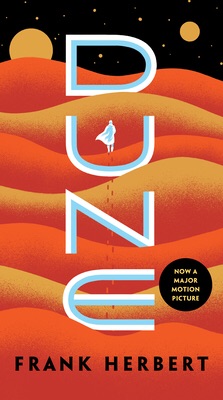
Exasperating science-fiction story and worlds that sententiously immerses the reader in a world they have never experienced before. Fandoms of Star Wars and other Sci-Fi genre series would not regret reading Dune, that is if they have not already. Dune is a harmonious concourse between a heroic novel and a political discourse, to which might be a difficult and heavy read, especially for the average reader. I blindly chose it as my introduction into science fiction and I was rather overwhelmed halfway through the book. But I was too intrigued to let it go.
We open up with our main characters being forced out of their planet Caladan, having to waive their Caladan Palace to their residence in planet Arrakis. They promise to make the best out of this desert, demised planet. That is when they start to discover a traitor among them. Paul Atreides, our hero and the son of Duke Leto and the Bene Gesserit, Jessica, navigates the desert like a true “Fremen”. Paul does not seem to struggle as much throughout the progression of the story, a trip or a stumble every now and then, but for the most part he is perfectly great. Could have been to his training by his mother, the Bene Gesserit Way of high mental training. However, I wished to see the hero experience extreme agony or failure for once, but it is a hero’s story after all. It further proofed the locals of Arrakis’ holy beliefs, that he is the long awaited Mahdi.
“Water from the sky,” Stilgar whispered.
In that instant, Paul saw how Stilgar had been transformed from the Fremen naib to a creature of the Lisan al-Gaib, a receptacle for awe and obedience. It was lessening of the man, and Paul felt the ghost-wind of the jihad in it.
The novel heavily touches upon many religious aspects. But mainly of Islam with the Fremen tribe—blended in with another religion: Zen Buddhism. The novel is also scattered with good amount of Standard Arabic words and terms. As a speaker, myself, I found it an easy read going through the book not having to look up the terms. One could tell the author did the required amount of research. The writing, however, still includes unnecessary racist narratives. Throwing terms such as: dirty, ignorance, brutality, etc. words we have become familiar with when the West attempts to describe Arabs and their culture and religion. That has been described time and again through the Western eye and this novel does not refrain from it either. While I get to enjoy the inclusion I still huffed and had felt my blood boil at the random stabs on Muslim culture, or what the novel pretends it to be, mixing it with other ancient religions. The representative of this abomination of a religion are the Fremen, but they show more of an American Taliban at their core. They also worship the giant sandworms. Thus, it was not really necessary to include the Sunni Muslims and their pure culture into such ignorant abhorrent mixture of a religion. No one is perfect but, surprisingly, the hero and his culture is.
The motivation and hunger for power can be felt in all of the characters. After a while, it becomes discouraging to pick up the book or read it as an afternoon, little fun read. Paul’s inner and outer struggle with the duty of becoming the next Duke, Jessica’s motherly instincts to protect her son and her unremitting care to help him with every step and remind him of his training, the Harkonnens — our main antagonist — and their plan to get rid of house Atreides. There is no character that seems to be lenient and just there for a comic relief. The closest I could think of is Gurney Halleck and his basilet instrument, but even Gueney have a dark history with the Harkonnens and is seeking dire revenge. You kind of don’t feel it while reading the book, too immersed, but a rare occasion where Paul and Jessica threw light-hearted jokes amongst each other when they were deserted after a Harkonnen attack gave me a sense of relief and downed on me how taut I have been all this while.
It might have been an ambitious approach to have read Dune as my first ever Science-Fiction novel but it has been a pleasure nonetheless. I had great time reading it, for the most part, but I had to take a break mid-way through the book and pick up something buoyant and carefree. I would love to have had a sprinkle of some comic relief, reading through eight hundred pages of power hungry characters succinctly trying to read through each other’s maneuvers and see through each other’s minds for the perfect attack plan, straining to survive politics and the harsh nature of the ecology of the desert planet. The usage of Muslims and their culture in such a dirty way is, I am afraid, something we will never run away from any time soon. The Western obsession with the Arabic culture is mind boggling when they cannot pay some respect to it and honor.
Frank Herbert has a unique way of grabbing the reader. The animation of the characters and the texture of the world interacting with them is palatable and real. The frequent quotations of religious sayings further added a breath of people and culture in the novel. While it is being a “hero’s journey”, the writing attempts to conceal the typical aspects of one. It is still, however, felt with Paul’s Messiah tendencies. Would Dune be recommended as an introduction to Science Fiction? Absolutely. I read somewhere the novel being called “The Father of Science Fiction” and the fact it precedes Star Wars further proofs the importance of it in this genre.

 Carpe Diem Society
Leave a comment