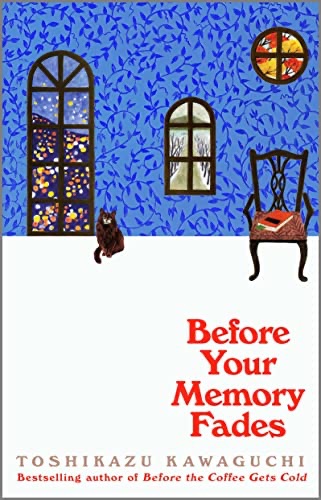
Third of the series that captivated us with the idea of traveling in time within the confides of a cafe, Toshikazu Kawaguchi’s Before Your Memory Fades (2022), which came after Before The Coffee Gets Cold (2015) and Tales From The Cafe (2020) continues the series. The books can be read in a random order since there are new stories and characters in each one, however, reading it in order is much preferred to keep up with the cafe owner’s story. To me it was a perfect morning or an afternoon read and very light weight. I enjoyed reading it at parks and cafes. The latter was a fantastical experience.
There is no particular main story but an on-going concept that flows throughout the books. In case you’re not aware, the rules are simple: whether you are going to the past or future, remain in your seat, return before the coffee gets cold. There are four new stories we follow in Before Your Memory Fades, a young women furious about her parents passing and leaving her alone, a comedian who was separated from his other duo comedian, a girl looking for her deceased sister, and lastly, a young man who’s working part-time in the cafe.
The story of a young lady called Yaoi Seto, whom her parents had died in a car-crash incident and her being passed around and bullied in her childhood was frustrating and heart-breaking, her built-up resentment and anger was highly understandable. At first, she found the rules to be ridiculous and didn’t deem it deserving of the time she spent to arrive from, what Kazu Tokita guessed, judging from the young woman’s accent, to be Osaka, all the way to Hakodate. But then—after pouring out her emotions at Reiji, the part-timer at the cafe,— she gave in to the that seat and returned to the past. The revelation she gets when she sees her parents was a great surprise and left the character and the reader with a soft reassurance, in contrast to what we were feeling at the beginning of the story.
The second one follows a comedian in his forties, Kohta Hayashida, disguised in a hat and sunglasses, blending seamlessly in the background and out of attention. Kohta is in a comedian duo with Gen Todoroki called PORDON DORON whom went missing after winning a grand entertainment prize. Since Kohta have been attending the cafe, his identity was hidden for the most part, that is until Reiji (whose aspiring to become a comedian himself,) was the first to recognize him. The comedian have been lurking in the cafe for three consecutive days, staying in from the moment it opens till it’s closed. His reason was a mystery, the cafe staff assumed him to be like any other customer, someone who is curious about the legend of the cafe. Turns out he was waiting for a specific someone who is going to take that seat. The relationship is then revealed between him, Gen, and Gen’s wife. I found their history to be a little complicated and sad, especially for people who eventually become the funniest duo in Japan and win a phenomenal prize for it. The part-timer must have received a lesson or two about becoming one, it is not always a flower path and not all celebs have grand lives, especially after achieving these heights and the people they share these moments. Which will lead us to Reiji’s experience to become one as the last story in the book.
We transition, thirdly, to the story of The Sisters. Reiko Nunokawa, who used to visit her sister, Yukika Nunokawa, that used to work part-time at the cafe. Yukika had passed away due to an extremely rare disease but her sister kept on visiting the cafe, asking if her sister had came in yet. Kazu Tokita, the waitress, would then play along instead of telling her the reality of what had happened to her sister. Due to the passing of the sister, Reiko was suffering insomnia and that affected her mentality.
Lastly, the part-timer. Reiji Ono is a university student who works at Donna Donna. He dreams of becoming the greatest comedian. Reiji’s childhood friend, Nanako Matsubara, visits the cafe frequently and has a friendly type of relationship with the staff of the cafe. Regardless of them being friends since kindergarten and throughout middle school, high school and university they both hold deep secrets about each other. I mean, it is relatable, those closest to us are the people we hold the deepest secrets from! We either don’t want to burden them with the reality or afraid of the rejection. We never know the reaction we will get so we hold on those secrets until they reveal themselves in ridiculously unexpected ways, like what happens to Reiji when he is finally closer to achieving his aspiring dream.
I will be honest, at first, I thought why would I read another book with the same on-going concept and similar stories? I only did because I was curious, why is the idea so important that there are series about it? What does Kawaguchi wants to tell me exactly? After reading Before Your Memory Fades I realised the necessity to plant the idea of: getting a closure. Nothing will change if we go to the past or future —everything is predestined and that’s realistic, what would actually change is our feelings. No more resentment but peace and happiness, no more regrets but satisfaction, no more denial but acceptance, no more hiding but clarity. Reaching a point where there is no confusion and misunderstanding but honoring the self by being slightly more honest. If we wanted to live a better life we have to reach certainty before our memory fades.
I have also pondered what the title of the book implied since none of the characters necessarily forgot about their issues and carried on. The way I see it now, “before you forget and move on, let’s get rid of the clouds and wake up to a clear sky”. You are never truly free from carrying unresolved resentments, regrets, denial and hidden feelings. Before you move on, let’s understand each other better. Coincidentally, I was going through a similar situation with the characters and wished I could go back in time. A month after reading the book I got a closure.
There is also the idea that people never know when is their last moment on earth. Throughout the book, Sachi, Kazu’s daughter discusses a book titled One Hundred Questions where it quizzes its readers in each questions with: “what would you do if the world would end?” Reiji realizes the urgency of the question and the uncertainty of when a person is going to die. If we don’t convey our feelings now then who knows if we can tomorrow?

 Carpe Diem Society
Leave a comment